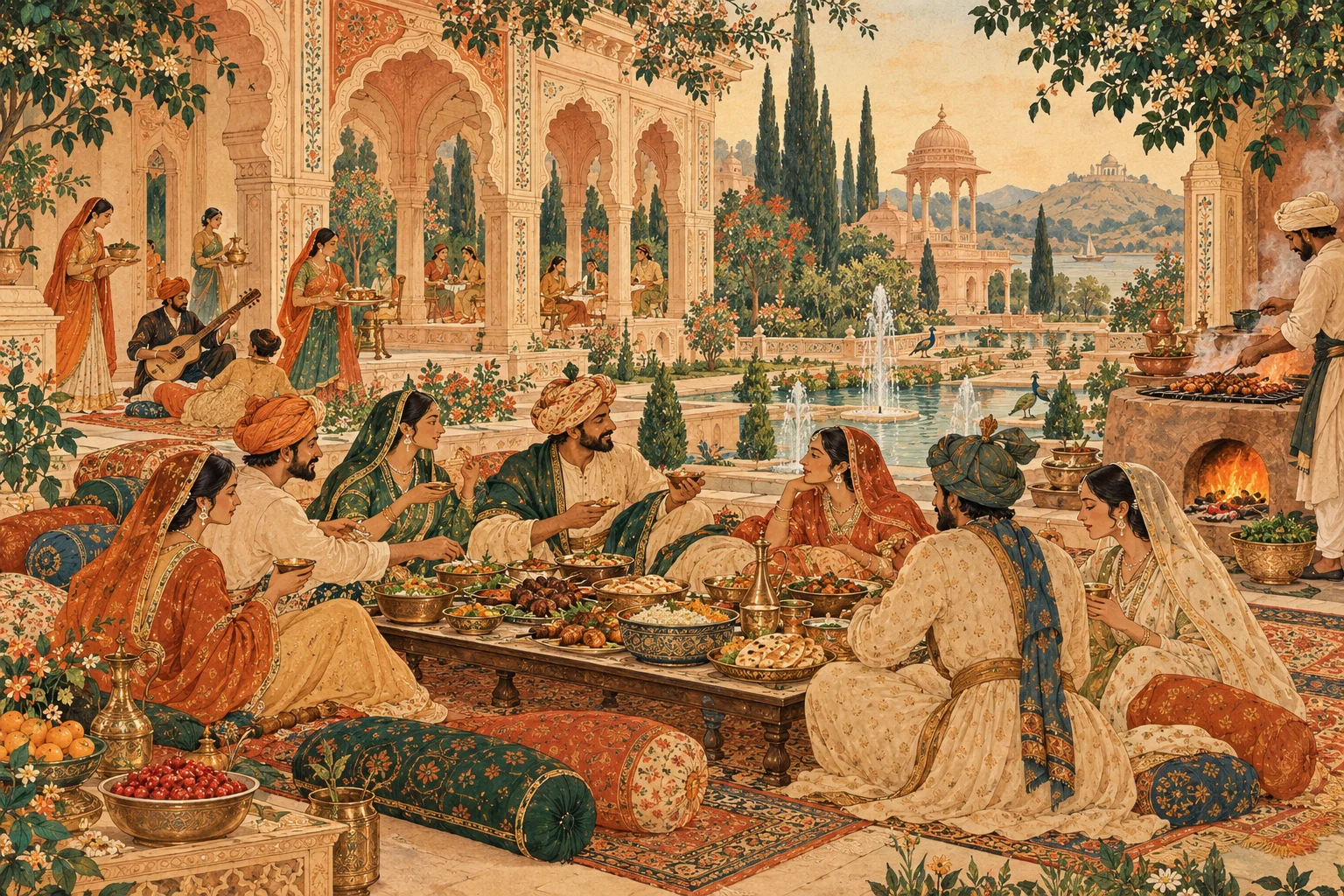
A good food story begins with something you can almost taste. A little ginger. The scent of cardamom. Warm bread arriving just as the conversation gets interesting. Open an old cookbook and the distant royal kitchen becomes wonderfully concrete: someone was deciding what to season, how to cook it and what to put beside it.
For Bhaijaan’s, these books offer a way to look more closely at the pleasures on our own table. Three texts make particularly good companions. They come from different courts and survive through different kinds of evidence, so we will keep their names attached to the stories. The details are far too interesting to flatten into one grand recipe.
First stop: the delights of Mandu
The Ni’matnama, usually placed around 1500, belongs to the Malwa court at Mandu, rather than a Mughal court. British Library curator Ursula Sims-Williams describes a work begun for Ghiyas al-Din Khilji and completed under his son Nasir al-Din Shah. The surviving manuscript, IO Islamic 149, is undated. In a samosa recipe reproduced from Norah Titley’s translation, cooked mince meets onion, dried ginger, garlic and aubergine pulp; saffron is ground in rosewater, and the filled pastries are fried in ghee. Read the curator’s account and recipe extract.
That combination invites a different sort of daydream from the usual palace banquet. Imagine the cook balancing a savoury filling with a fragrant finishing note. Imagine the first crack of pastry, then the softer centre. A small, hand-held bite can carry as much care and ceremony as a whole laden table. That is a lovely thought to bring to an ordinary lunch.
Akbar’s kitchen, down to the ingredients
Abu’l Fazl’s Ain-i Akbari gives us another kind of close-up. A’in 24 lists kebab ingredients including meat, ghee, ginger, onion, cumin, coriander, pepper, cardamom and cloves. Its malghubah combines meat with curds, ghee, onion, ginger and cloves. Then A’in 25 turns to bread, distinguishing oven-baked loaves from thin breads cooked on an iron plate. Explore the translated recipes and bread chapter.
Read those lists slowly and the kitchen starts to feel less remote. There is an ingredient you recognise, then another. Our own Tikka Boti uses yoghurt, ginger, garlic, cumin and coriander. The shared ingredients make a useful tasting connection; they do not establish an identical recipe or a direct line of descent. What catches our attention is the possibility of balance: a rounded base, aromatic seasoning and a bite you want to follow with warm bread.
Opulence was an operation
Abu’l-Fazl’s account of the imperial kitchen, A’in 23, makes magnificence surprisingly practical. It names a Master of the Kitchen, the Mír Bakáwal, alongside assistants, storekeepers, tasters and a writer. Regional buying brought rice from places including Bahraich and Gwalior, ghee from Hisar Firoza and certain foods from Kashmir. A kitchen garden supplied fresh greens. The feast began long before anyone lit a cooking fire.
Service had its own ceremony. Gold and silver dishes travelled wrapped in red cloth; copper and china in white. Contents were identified and sealed, and a written vessel list accompanied them. Tasters checked the food at several stages. Abu’l-Fazl even reports that preparations could be advanced enough to supply a hundred dishes within an hour of an order. That is the court author’s description of the establishment’s readiness, rather than a claim that the emperor ate a hundred dishes.
The spice cupboard gives luxury a number. In A’in 27’s price table, saffron is listed at 400 dams per ser and cumin at two. For the same recorded weight, that makes saffron two hundred times the price of cumin. These are the account’s historical average prices, not a conversion into modern money. Put saffron beside almonds, pistachios and ghee in Zard birinj, and the opulence becomes something you can imagine smelling as well as seeing.
Yet the table also made room for bread, curds, pickles, fresh ginger, limes and greens. A share for dervishes was set aside before the emperor began his meal. This is a richer picture than splendour alone: an elaborate household, a carefully supplied kitchen, and familiar accompaniments beside its most magnificent dishes.
A surprising paneer connection
The Nuskha-e-Shahjahani is associated with Shah Jahan’s reign. Translator Salma Yusuf Husain explains that the manuscript names neither its compiler nor a compilation date. In her published Zeer Biryan Paneer recipe, fried paneer is coated with yoghurt, saffron and cardamom, then cooked with rice and green gram. This is a rice dish, distinct from today’s Paneer Tikka. Read Husain’s interview and the recipe. Her modern book, The Mughal Feast, is described by its official publisher listing as a transcreation of the Persian manuscript.
We love the invitation here: give paneer the attention of a centrepiece. Our version begins with spiced yoghurt, ginger and garlic, and becomes part of the plate you choose. A naan roll, a salad bowl or a spread to share each offers a different way into the same flavour. History can sharpen your curiosity about a familiar ingredient without asking you to recreate an entire feast.
Fruit, fragrance and a sealed pot
For a more elaborate Shahjahani preparation, turn to Amba Pulao in an authorised excerpt from Husain’s modern book. Lamb, mango and rice meet a sequence of stock-making, seasoning, layering and gentle covered cooking. Nuts and raisins finish the dish. This is the translator’s published transcreation: a way to explore the repertoire through a modern cooking text.
Husain also describes Yakuti pulao, combining pomegranate-coloured and pale rice with silver leaf, in her account of the Shahjahani kitchen. Here the spectacle is deliberate: colour, fragrance and the appearance of the finished platter all contribute to the occasion.
What the names carry
Rekhta records Persian roots for tikka, with a culinary meaning of a roasted piece of meat. Boti names a small piece of meat. Those words help us understand the menu, while the historical kebab entry gives us a real comparison of seasonings. Modern tandoori cooking has its own living geography: India’s tourism account of Amritsar connects tandoori chicken and fish tikka with settlers from Peshawar and Lahore.
Read with a cook’s curiosity
Ready to meet the names behind the feast? Open Akbar’s dastarkhwan for eight preparations from the imperial account: Shullah, Harísah, Qalyah and more. Then visit the Recipe Room for original records and modern cooking steps, or follow the guest to the table in our story of mehman-nawazi.
Try approaching each entry with three questions: what is the main ingredient, what brings the fragrance, and how is the food cooked? A familiar name can tempt us to picture the version we already know. Looking at the actual ingredients and method gives the older dish room to surprise us. Follow the links below to compare the passages yourself; the recipe, the translator’s explanation and our own tasting connection each add a different part to the conversation.
Bring the reading back to your plate
Start with our Malai Boti if the fragrant side of the story appeals. Yoghurt, cream and cashew paste make its mellow foundation; cardamom and white pepper give you something to look for as you taste. Let the first bite linger before adding sauce. Which note arrives first? Does the next bite, with salad or bread, feel different? Our guide to the masala tin has more little prompts for that kind of exploration.
For a bolder direction, our Tandoori Boti brings together yoghurt, Kashmiri chilli, ginger, garlic and aromatic spices. Tangri offers another experience again: three bone-in drumsticks, with a little more time spent enjoying each piece. These are dishes on our present-day menu. Their pleasure belongs in the here and now, even while the reading sends your imagination travelling.
You can follow the wider story in From courtly feasts to the high street, where our imagined royal welcome meets the history of culinary exchange. Or turn towards the everyday in Eat well. The two belong together at our table: curiosity about where food has travelled, and care for how we make room for it in our lives today.